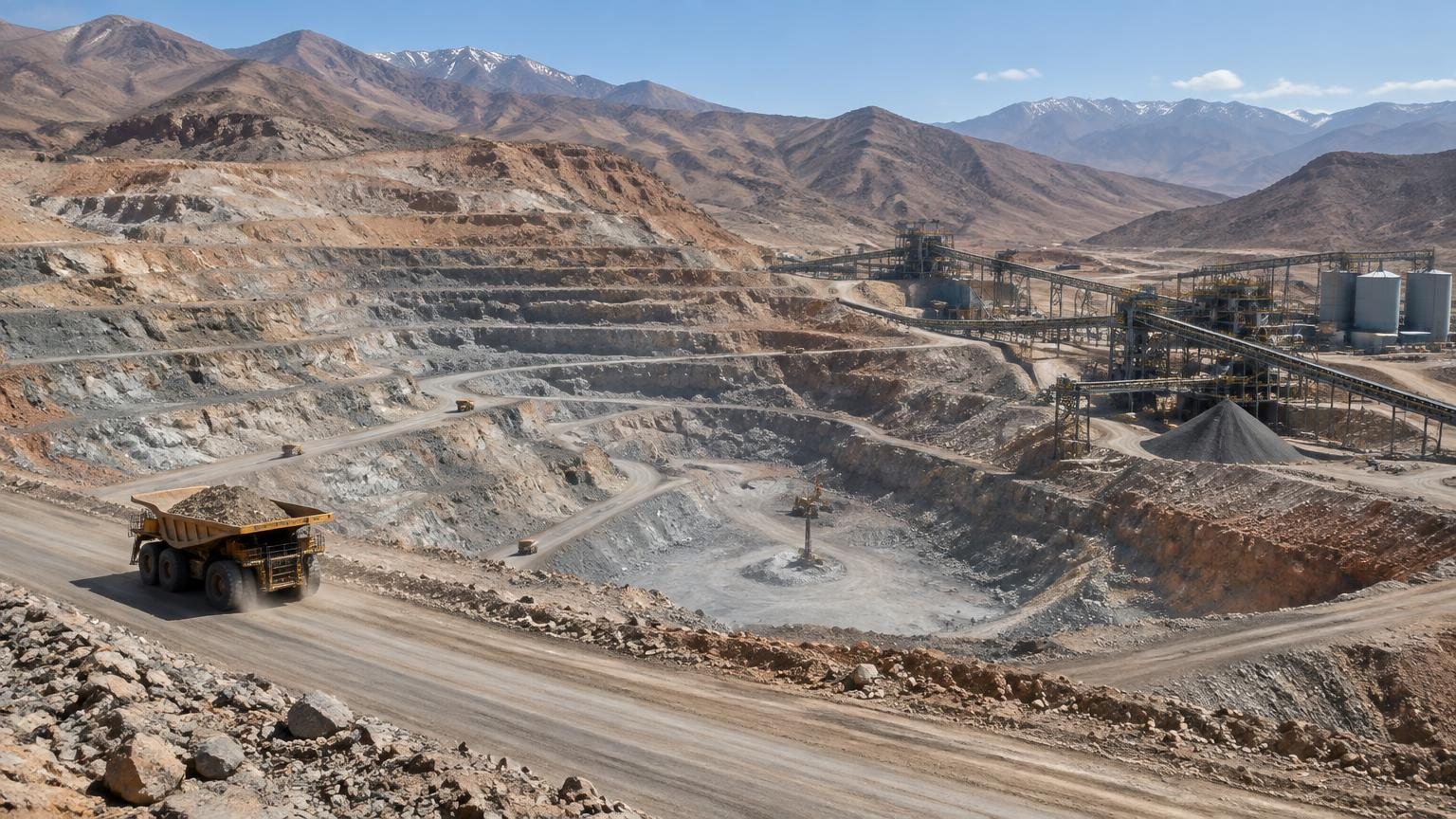
Iran's mining and metals sector

A practitioner's guide to iran's mining and metals sector for foreign investors: framework, opportunities, figures and entry routes.

Iran's mining and metals sector — Mining industry of Iran

Mining industry of Iran

Short answer

Iran holds roughly 7% of global mineral reserves across more than 60 commodities, and remains one of the least systematically explored major mineral provinces in Eurasia.

Key takeaways

  • Share of world reserves: ≈7%
  • Commodities: 60+ minerals
  • Lead commodities: Copper, zinc, iron ore, stone
  • Licence types: Exploration, discovery, exploitation

Reviewed by Global Investment Iran advisers.

Key figures

Share of world reserves
≈7%
Commodities
60+ minerals
Lead commodities
Copper, zinc, iron ore, stone
Licence types
Exploration, discovery, exploitation
Regulator
Ministry of Industry, Mine and Trade
Bottleneck
Processing and refining capacity
Copper reserves
≈2.6 bn tonnes of ore, mostly porphyry
Iron ore reserves
≈2.7 bn tonnes, Central Iran and Sangan
Zinc
Among the largest reserve bases worldwide (Mehdiabad)
Steel output
≈30 mt/yr crude steel, top-10 producer
Main export route
Bandar Abbas by rail and road
Foreign ownership
Up to 100% via an Iranian-registered holder

Step-by-step process

  1. 01 · 2–4 weeks

    Block screening and title search

    Identify released or acquirable blocks, pull the licence file at the provincial mining registry and verify work-commitment history and surface-rights overlap.

  2. 02 · 3–6 weeks

    Iranian holding entity

    Register a PJSC to hold the licence; foreign shareholding up to 100% is permitted in most mineral categories.

  3. 03 · 2–4 months

    Exploration licence or licence transfer

    Apply for a new exploration licence over the block or transfer an existing licence, with a committed work programme and budget.

  4. 04 · 12–24 months

    Exploration and discovery certificate

    Execute the work programme; a demonstrated resource converts the licence into a discovery certificate.

  5. 05 · 6–12 months

    Mine plan and exploitation licence

    Approved mine plan, environmental clearance and water allocation convert the certificate into an exploitation licence with a fixed government royalty share.

  6. 06 · 2–4 months

    FIPPA cover and offtake

    Register imported capital under FIPPA and put concentrate offtake or downstream processing in place before production ramps.

Indicative costs

ItemIndicative cost (USD)Notes
Title and licence diligence8,000 – 25,000Registry file, overlap and commitment review
Holding entity registration4,000 – 9,000PJSC plus tax and social security files
Exploration licence application3,000 – 10,000Fees, mapping and technical filing
Committed exploration programme250,000 – 2,000,000+Mapping, geochemistry, drilling; block-dependent
Mine plan and environmental clearance40,000 – 150,000Includes water allocation study
Government royaltyCommodity-specificSet in the exploitation licence

Documents you need to provide

  • Corporate documents of the foreign investor, consular-legalised and translated
  • Technical capability evidence: prior mining or exploration track record
  • Committed exploration work programme with budget and timetable
  • Source-of-funds evidence and the capital import schedule for FIPPA
  • Environmental and water-use study for the exploitation stage
  • Draft joint-venture or licence-transfer agreement with the current holder

Get a fixed-fee quote

Send us your sector, ownership structure and target timeline and we will return a scoped fee and schedule.

Request a quote

Overview

Iran holds roughly 7% of global mineral reserves across more than 60 commodities, and remains one of the least systematically explored major mineral provinces in Eurasia.

Copper, zinc, iron ore and decorative stone dominate production. Modern exploration technique applied to historically mapped but under-drilled ground is where the value asymmetry sits.

The concession ladder

Rights move through three stages: an exploration licence over a defined block, a discovery certificate once a resource is demonstrated, then an exploitation licence tied to an approved mine plan. Each stage has expiry and work-commitment conditions.

Most disputes foreign investors encounter come from inherited licences with lapsed work commitments or unresolved surface-rights overlaps, so title diligence precedes valuation work.

Where the opportunity concentrates

The Urumieh-Dokhtar magmatic belt hosts the porphyry copper systems; Zagros and central Iran host zinc-lead and industrial minerals. Processing capacity, not ore, is the national bottleneck — concentrate frequently leaves the country unrefined.

Downstream investment in concentrators, smelters and value-added metals therefore competes favourably with greenfield exploration on risk-adjusted terms.

Practical constraints

Water availability governs project design in most Iranian mining districts, and dry or closed-loop processing is often a licensing condition rather than an optional efficiency.

Power supply, rail access to Bandar Abbas and equipment import channels are the other three items that decide whether a resource becomes a mine.

Commodity by commodity

Copper is the flagship: the Sarcheshmeh, Sungun and Miduk porphyry systems anchor a national concentrate stream that outpaces domestic smelting. Zinc is concentrated at Mehdiabad and Angouran, one of the world's larger zinc-lead reserve clusters, with sulphide-oxide blending the key metallurgical question.

Iron ore feeds a crude-steel industry of roughly thirty million tonnes a year, so pellet and concentrate projects have guaranteed domestic offtake. Chromite, decorative stone, silica, feldspar and celestite make up a large, fragmented industrial-minerals segment where small foreign operators can enter at modest capital.

How foreign investors actually enter

Three routes dominate. Acquiring an equity stake in a licence-holding Iranian company is fastest and shifts the work to title diligence. Farm-in against a committed exploration budget suits explorers who want geology exposure without buying a legacy balance sheet. Building a processing plant against third-party concentrate avoids licence risk altogether and addresses the national bottleneck.

Whichever route is chosen, the Iranian holder must be a registered entity, so company registration and, where capital is imported, a FIPPA licence run in parallel with the mining approvals rather than after them.

Frequently asked questions

How does a foreign investor obtain a mining licence in Iran?

Through the three-stage system: exploration licence, discovery certificate, then exploitation licence. Foreign investors typically acquire an existing licence via a joint venture and verify work-commitment compliance during diligence.

Which minerals does Iran produce at scale?

Copper, zinc, iron ore, decorative and dimension stone, plus significant chromite, lead and industrial minerals.

What is the main risk in Iranian mining deals?

Title. Lapsed work commitments, overlapping claims and unclear surface rights are common in inherited concessions.

Is processing capacity available locally?

Partially. Concentrate capacity exceeds smelting and refining capacity, which is why downstream processing projects attract policy support.

Can a foreign company own an Iranian mining licence outright?

A licence is held by an Iranian-registered entity, but that entity can be up to 100% foreign-owned under FIPPA in most mineral categories. In practice foreign investors hold through a PJSC and pair the licence with a FIPPA licence covering the imported capital.

What royalty does Iran charge on mineral production?

A government share (royalty) is set per commodity and per licence, typically in the range of a few per cent of the gate value of extracted ore, and is fixed in the exploitation licence alongside the approved mine plan.

How long does an Iranian exploration licence run?

An exploration licence is usually granted for one to two years with extensions tied to demonstrated work commitments. Failure to meet the committed programme is the most common reason a licence lapses and becomes contestable.

Which Iranian mining districts are open to new entrants?

The Urumieh-Dokhtar copper belt, the Sanandaj-Sirjan zone for zinc-lead and gold, the Central Iran block for iron ore and industrial minerals, and Khorasan for chromite and dimension stone all have blocks released in periodic tenders.

Discuss this topic with our advisers

We advise foreign investors on market entry, licensing and structuring in Iran.

Contact us