Iran Business Guide
Comprehensive information about Iran's business environment, regulations, infrastructure, and investment opportunities.
Visual Gallery
Explore Iran's industrial zones, infrastructure projects, historical heritage sites, and tourism destinations through our curated collection of professional photography.

Milad Tower — Tehran
Modern Iran
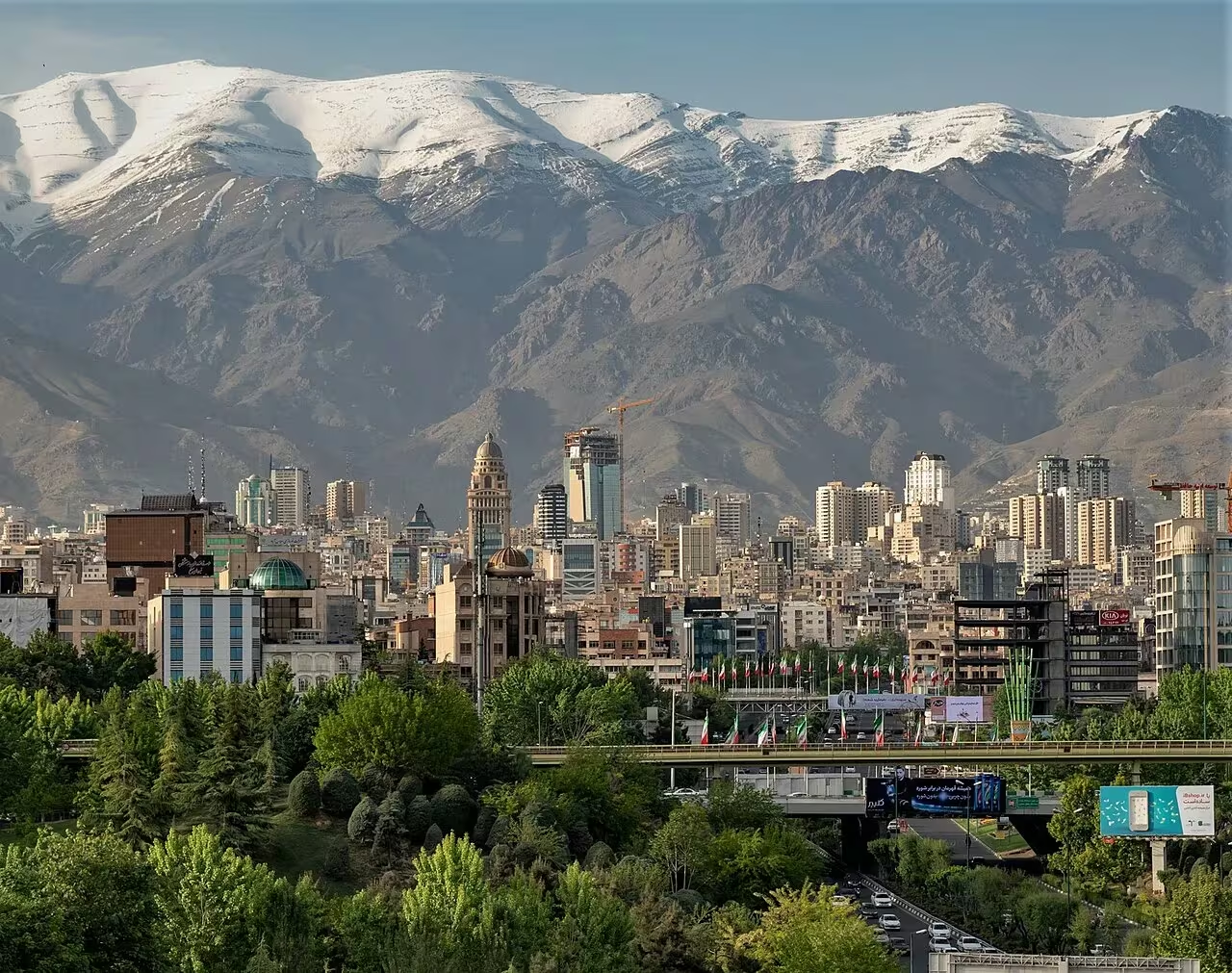
Tehran Skyline & Alborz
Modern Iran

Tabiat Bridge — Tehran
Modern Iran

Iran Mall — Tehran
Modern Iran

Tehran International Tower
Modern Iran

South Pars Gas Complex
Industrial Zones

Iran Khodro Vehicle Plant
Industrial Zones

Imam Khomeini International Airport
Infrastructure

Highway Network
Infrastructure

Railway System
Infrastructure

Persepolis - Ancient Capital
Historical Sites

Naqsh-e Jahan Square - Isfahan
Historical Sites

Sheikh Lotfollah Mosque
Historical Sites

Caspian Sea Coast
Tourism

Mountain Landscapes
Tourism

Traditional Bazaar
Tourism

Ancient Gardens
Tourism
Business Practice & Regulations
Understanding Iran's regulatory framework is crucial for successful operations.
Foreign Investment Law
FIPPA governs admission and protection of qualifying foreign investment. OIETAI investment licensing is separate from incorporation, activity permissions and foreign sanctions review. Confirm which entity and capital components a licence covers.
Business Registration
Choose the vehicle around the activity and investor structure. A subsidiary, branch and representative office have different purposes and obligations. Prepare legalised corporate records and identify beneficial owners before submitting an application.
Compliance Requirements
Map corporate filings, tax and VAT duties, employment obligations and sector permissions into a dated responsibility checklist. Rules vary by entity and activity; investment approval does not replace operating compliance.
Sector Restrictions
Check the actual activity, product, counterparties and ownership structure. Eligibility under Iranian law and legality under an investor’s home-jurisdiction sanctions rules are separate questions; obtain both reviews before commitment.
Free & Special Economic Zones
Iran has numerous free zones offering significant tax and regulatory benefits.
Kish Free Zone
Evaluate Kish against customer access, freight and staffing needs. Verify the licence, premises and current tax conditions with the zone authority; visitor entry arrangements do not constitute permission to work.
Chabahar Free Zone
Chabahar provides Indian Ocean port access. For a logistics or manufacturing project, verify the specific terminal, customs procedure, inland connection and available utilities rather than infer readiness from the zone designation.
Qeshm Free Zone
For Qeshm, distinguish island geography from the licensed operating site. Check sea freight, utilities, mainland sales rules and environmental permissions before choosing a manufacturing or re-export model.
Special Economic Zones
Special economic zones and free trade-industrial zones are not interchangeable. Compare the applicable regime, permitted activity, customs boundary and current tax conditions for the specific location.
Foreign Investment & Incentives
Iran offers attractive incentives for foreign investors across multiple sectors.
Tax Incentives
Confirm the legal basis, eligibility date, activity and filing conditions for any relief. Income-tax concessions do not automatically remove VAT, payroll obligations or customs charges; calculate each separately.
Infrastructure Support
Request site-specific evidence of power, water, transport and telecommunications capacity. A development plan or promised connection is different from a commissioned service with enforceable capacity and tariff terms.
Joint Venture Opportunities
Assess the proposed partner’s ownership, finances, permissions and delivery record. Define reserved decisions, funding obligations, related-party transactions, dispute handling and exit rights before signing.
Long-term Stability
Qualifying investments may obtain protections under FIPPA, subject to licence terms and applicable requirements. These do not remove currency, sanctions, bank-acceptance or commercial risk; document the residual risks.
Travel Guide for Investors
Essential information for planning your business visit to Iran.
Visa Requirements
Confirm visa and entry requirements for your nationality, purpose and itinerary with the relevant authority. A business meeting, employment and site work may require different permissions. Allow for review before booking non-refundable travel.
Best Time to Visit
Match travel dates to the climate of the destination, public holidays and confirmed counterpart availability. Verify exhibition dates with the organiser and allow time between cities for realistic meeting schedules.
Business Culture
Agree meeting objectives, decision-makers and written follow-up. Use qualified interpretation where needed and confirm names, dates and commercial terms in the contract language rather than rely on an informal conversation.
Accommodation & Transportation
Choose accommodation around confirmed meetings and transport access. Check current payment acceptance, transfer arrangements, communication needs and travel advisories before departure; do not assume foreign cards will work.
The investor briefing on Iran in one read
Iran is the 17th-largest country by area, the second-largest economy in MENA, and the 4th most populous in the region. Its position between the Persian Gulf, the Caspian, and Central Asia makes it both an end market and a transit corridor — facts that should anchor any entry thesis.
Demographics
A median age of ~32, with a fast-urbanising consumer base concentrated in Tehran, Mashhad, Isfahan, Karaj, Shiraz, and Tabriz. Each of those metros alone exceeds the population of many European capitals.
Geography & climate
Four climatic zones support a uniquely broad agricultural footprint — saffron in Khorasan, citrus on the Caspian, dates in Khuzestan, pistachios in Kerman — alongside heavy industry clusters on the Persian Gulf.
Currency & inflation
A managed multi-rate FX environment (NIMA, SANA, free market) and structurally high inflation make USD/EUR-based modelling essential and local-cost arbitrage a real source of margin.
Frequently asked questions
How safe is Iran for business travel?+
Major business cities are safe and well-served by domestic aviation and quality hotels. The practical constraints are visa logistics and card payments — both of which we pre-arrange for clients.
Is English widely spoken?+
In the business, academic, and hospitality layers — yes. For any regulator, courtroom, or notarial interaction, a sworn translator is required and standard.
What is the working week?+
Saturday to Wednesday, with Thursday and Friday as the weekend. Plan calls accordingly — Sunday morning Tehran time is usually the optimal global slot.
The operating details that decide whether an Iranian entity runs smoothly
Most guides to doing business in Iran stop at registration. The problems that actually consume management time arrive afterwards: the Iranian fiscal year that ends on 20 March and reshapes every reporting calendar, quarterly VAT filings in Persian, mandatory social security registration for every employee, an accounting system that must be maintained locally, and a banking relationship that determines how quickly suppliers get paid. This section sets out the recurring obligations and the rhythms a foreign parent needs to plan around.

Recurring compliance calendar for an Iranian entity
| Obligation | Frequency | Typical deadline | Consequence of missing it |
|---|---|---|---|
| Corporate income tax return | Annual | Four months after 20 March year-end | Penalties and loss of exemption entitlements |
| VAT return | Quarterly | 15 days after quarter end | Fines and blocked tax clearance certificate |
| Payroll and social security (TAMIN) | Monthly | End of following month | Interest, and personal liability for directors |
| Statutory accounts in Persian | Continuous | Maintained locally at all times | Assessment on estimated income during audit |
| Annual general meeting filing | Annual | Within four months of year-end | Registry non-compliance affecting bank operations |
| Foreign investment reporting (FIPPA) | Annual | As set in the licence | Weakened transfer and protection position |
Indicative planning benchmarks based on our engagement experience; actual timelines vary by sector and file.
Setting the entity up to run without friction
- Align group reporting to a 21 March – 20 March fiscal year from day one
- Appoint a local accountant before, not after, the first VAT quarter
- Register every employee with social security from their first day
- Keep board and shareholder resolutions in bilingual form to avoid re-translation
- Maintain one Persian-speaking finance contact with signing authority in-country
- Diarise the Nowruz closure — nothing filed or approved moves for roughly two weeks
Frequently asked questions
When does the Iranian fiscal year end?
On 20 March, the last day of the Iranian calendar year. Corporate tax returns are generally due within four months of that date, so a foreign parent on a December year-end will run two reporting calendars in parallel.
Does an Iranian company need a local accountant?
In practice, yes. Statutory books must be maintained in Persian and filings are submitted through Iranian systems, so a local accountant or firm is effectively a requirement rather than a convenience.
What is the corporate tax rate in Iran?
Twenty-five per cent on mainland taxable profits, with long-standing exemptions available for entities established in the free zones. Value added tax applies separately at the prevailing standard rate and is filed quarterly.
Can a foreign parent hold 100 per cent of an Iranian company?
Yes in most sectors, both on the mainland and in the free zones. Restrictions apply in a limited set of strategic areas, and some tenders or licences in practice favour a local shareholding even where the law does not require one.
How long does it take before an entity can trade normally?
Registration itself typically completes in four to eight weeks, but full operating capability — tax file, VAT code, social security registration and a working bank account — usually takes three to five months from the first filing.